
"Enjoy.
Deal with Now.
Enjoy whatever triumphs she has - there will be many."
This is how the neurologist, Dr. Cowan, wrapped up our appointment today. This is good advice for us - to focus on enjoying Taylor everyday, not worrying about the future (or trying at least), and celebrating any milestones Taylor reaches - big and small. We had anxiously awaited this appointment because we were hoping the neurologist would answer some large questions for us. And if not, at least we would know what we can know now, and what we can't know.
We really liked Dr. Cowan. He was very quiet, sweet with Taylor, and spent well over an hour with us explaining, answering questions, and reviewing Taylor's MRI with us. At the end, we didn't learn measurably more than what we entered the room with. But, we're comforted that we're on the right track and doing what we can for Taylor.
We had a disturbing moment before we even made it to her appointment. As we were entering the elevator at Children's Hospital, a little girl about 8 years old was standing there with her mom. She had a bit of a glazed look on her face and just as I was about to worry about her, she just tipped over and banged her face against the elevator. Her mom just took her by the arm and led her off the elevator. David offered to help, but her mom said they were fine. This is what I mean by counting our blessings every time we're there.
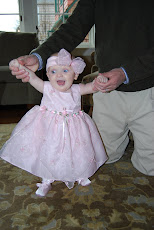
Taylor quickly became known in the neurodevelopment office as the "baby with the beautiful blue eyes." They really made us feel "normal" and recognized Taylor's special gifts. She was happy through-out the appointment, smiled, and practiced her new noises (a fake cough and lots of goo's...).
Dr. Cowan confirmed that she does have a version of Septo-Optic Dysplasia. He termed this condition as "not common, but not extraordinarily rare". He did note that he has a high bar for "rare" though since they see conditions most doctors don't. Essentially, her brain needs to learn new pathways and utilize some of the many back-up systems of the brain. He said he would be far less concerned with labels though, and more focused on treating symptoms. He extensively examined Taylor, asked lots of questions about her development, and did several development tests with her. He agreed that her motor development is delayed, particularly in her hands. She doesn't have spactisity or low muscle tone (conditions fairly common with SOD). He said it's difficult to predict the severity of her condition - he doesn't think it will be severe, but she will have some motor delays and probably fall somewhere in the middle of the broad range of possibilities.
He also is concerned with her vision. He doesn't think she is tracking objects well and said vision issues can confuse the situation (i.e. if she isn't seeing well, she won't reach for objects she can't see, etc.). It can be very difficult to tell where the problem lies at her young age - a motor development issue vs. vision problems. He thinks the way information is going from her eyes to her cortex is sluggish and inefficient - thus the tracking problems. He said her cortex is normal, so the pathways to the cortext are slow - either immature, or abnormal. It's too early to know. He's seen people with cortical vision impairments (due to strokes, car accidents, etc) make great strides and can improve greatly. Unfortunately we just need to keep doing what we're doing in this area and wait until she gets older to have a better sense of her vision and what we can do if there are issues. This is frustrating because we'd love to help this area immediately, but she's simply too little to know what problems, if any, she's facing.
The area I'm most worried about is cognitive (i.e. intelligence). Unfortunately this is an area they can't know much about yet because even normal babies aren't hitting any observable milestones in this area yet. Things we can look for at her young age are socialability, understanding and recognizing people, and object permanence (simply put, peek-a-boo). This is encouraging because Taylor definitely recognizes her family, has shown preferences for her family and demonstrated stranger awareness/anxiety, and will babble at/with you. We won't have a great sense of this area though for many months, if not years. We surely hope to develop patience as our next virture.
Re the MRI of her brain, he said the white and gray matter (large parts of the brain) look normal, cortex (which controls vision), and parts of the brain that control coordination and movement look normal. This is good news - hopefully once her brain learns new pathways to connect the right and left hemispheres of her brain (since her corpus callosum is missing), she will make up ground quickly. She has more fluid on her brain than normal and her ventricals are misshaped (known as colpoceplaly), but both are associated findings with her corpus callosum being absent (i.e. there is extra space in her brain so the fluid and ventricals have filled the space). He said it's difficult to predict what the brain structure will mean for her future function - lots of "normal" people have abnormal brains and lots of "challenged" people have normal brains. The brain really is a great mystery.
He stressed that the important charts to watch are how she tracks against development milestones, not what the MRI says. He will track this carefully for us and over time be able to make more specific suggestions re her future potential. He also stressed that kids surprise them all the time and just when you think a kid has plateaued, they learn entirely new skills.
Dr. Cowan said the Boyer Clinic is really good ("premier" for our area), encouraged us to continue with regular therapy and stimulate/play with her often. He said we will likely hear of "magic formulas" that might help her, but he encouraged us to trust the experts we are working with and that "she will do what she can do."
He reviewed our initial endocrine results for us and they were positive - her bone age is normal and her hormone (including thyroid, cortisol, cortisone, etc) and electrolyte levels were normal. He said her insulin growth factor was a little low, but her other growth hormone levels were fine, so it likely doesn't mean anything. We still need the full report from the endocrinilogist, but this is encouraging. Of course, she may develop issues in this area over time, but in the spirit of "deal with now", we'll savor the good report.
He relieved a few concerns, namely:
- Other than endocrine (which can be managed with medication), there are no long-term health concerns. Developmental delays yes, but her health is not at risk.
- Tumors are unlikely to develop (as rare as for other kids) and we don't need to worry about this (there was a note on her MRI about watching for this, so we were concerned).
- Seizures are not a dominant or primary issue with this condition and shouldn't develop. They might, but it's unlikely.
Unfortunately he didn't say what I wanted to hear "she'll be fine". But we were prepared for this. We are going to just have to wait and see how she hits the milestones. We'll see him every 3 months and continue with opthamology and endocrinology appointments.
Now that we have the most crucial appointments out of the way, we need to focus on living normally - helping Taylor of course, but living normally as a family. Today I relied heavily on the Serenity Prayer:
"God grant me the serenity to accept the things I cannot change, courage to change the things I can, and wisdom to know the difference."
David and I agreed that we are still counting on a fabulous, "normal" life for Taylor. And she will be fine - regardless.


No comments:
Post a Comment